How being an immigrant mother of children with autism can make you doubt even your own instincts.
I had a lonely childhood. I have two older sisters, who were already best friends by the time I was born, and I am a mini intruder who snuck into their afternoon games. Although we were girls and sisters, in those days we didn’t have much in common. We had a cousin who was younger than me that shared his cars with me, and I shared my dolls with him.
At home there was also a rule: no one could go out to play with other children on the street, something very normal, of course, but one that worried my mother who had to attend to other obligations. Maybe we could not play in the street with the neighbors, but the cousins were a blessed treasure.
So, in my childhood, I grew up surrounded by my family. When they visited us or we visited the cousins they were memorable occasions, of laughter, games, horror stories, and of jokes and riddles. I never had many luxuries, but I did grow up with beautiful memories of family outings, in the field, running, playing, and growing.
As an adult, and newly married, life brought me to this country. My husband and I had no family here. We practically started from scratch, and it was not long when our first child was born. A short time later the birth of some adorable twins, who made our life in the United States not so lonely, and who filled the house with bustle… but not many words.
As long as I can remember, and I reckon my memories date back to when I was about three years old, I always liked talking, with everyone! I think I was a bit outgoing, and obsessive with letters, and reading. Not so much because of the story, but because of the speed at which I could read.
When my oldest son was three years old, he barely said a few words. His younger siblings talked less, not to say they didn’t. One of them laughed a lot, and the other sometimes seemed not to listen. He just stared distractedly and didn’t pay attention when we called his name.
I began to feel that something was wrong. Visits to the pediatrician always ended with phrases like “children learn at their own pace,” or “some children speak later.” However, something told me, now I know it was my instinct, that there was something wrong with my children. I thought to myself that because they were not around other children and that for obvious reasons, they did not have cousins close, maybe what was delaying his language.
My husband and I decided that the best way to help our children was for them to start school early to spend time with other children their age. We enrolled them in the Head Start program, and there we met a person, now a very dear friend, who listened to us and helped our children receive therapy at school, and a diagnosis.
It was not easy to know that our three children were on the autism spectrum, at different levels, but it was the beginning of a journey of challenges and hope. Having the diagnosis helped us to understand them better and to look for therapies and resources that could help them to develop their potential, but above all to be able to communicate.
I changed my pediatrician, practiced my English more, learned to drive, and became the main advocate for my little ones. We have experienced fear, uncertainty, sleeplessness, but love moves us, and each therapy, each effort has been worth it.
I learned to believe more in my instincts, and to not allow my limitations of a language barrier, or being an immigrant, limit the opportunities for our children.
A diagnosis can be scary, but it is the first step towards a better future.*
About the Author
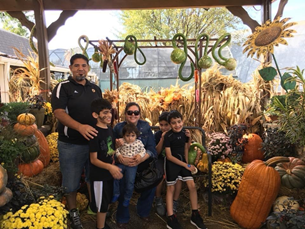
Nancy Aguila, an exemplary mother of four children, three of which have autism, shares her personal story that describes how her children’s diagnosis had implications in her life as an immigrant and with her motherhood. Aguila is a newspaper and media writer for the past 8 years, and is a strong advocate and community leader in a support group in Memphis, Tennessee that focuses on helping Hispanic families with children with disabilities. A mother that fought many battles, now shares one of the most important, having a new diagnosis in a foreign land far from her family.
*This article is a transcreation from Spanish.