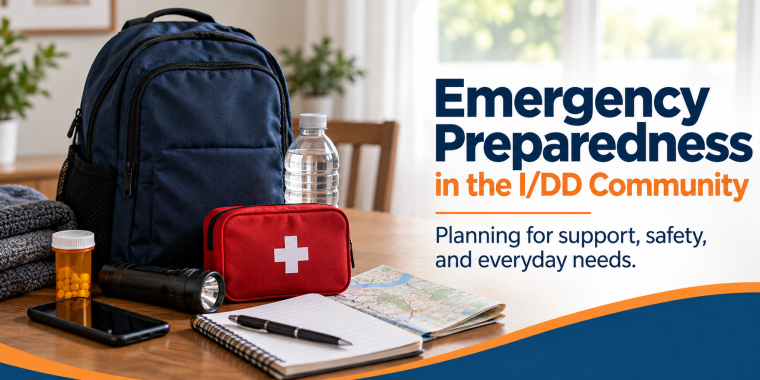
Emergencies do not discriminate, but their impacts are not experienced equally. For people with intellectual and developmental disabilities (I/DD), preparedness must account for individual support needs while recognizing an important reality: no emergency plan can anticipate every situation.
The response needs encountered during and immediately following Hurricane Helene and its devastating impacts on East Tennessee reinforced this lesson. Emergencies come in many forms, and their effects can be unexpected. Flooding, damaged infrastructure, power and communication outages, transportation disruptions, and isolated communities demonstrated how quickly normal systems of support can be interrupted. An emergency may make evacuation necessary; but another may make evacuation unsafe or impossible. Roads may be inaccessible, communication systems may fail, or circumstances may change before a planned response can be fully implemented.
Hurricane Helene reminded us that preparedness is not about predicting every emergency. It is about creating a foundation strong enough to adapt when circumstances change, sustain people when resources are disrupted, and connecting them to longer-term support and recovery.
We cannot create a plan for every possible scenario. What we can create is a strong foundation that provides flexibility and helps sustain individuals through the uncertainty until longer-term solutions can be implemented.
Building Strong Foundations
For the I/DD community, emergencies can have significant physical and emotional impacts, particularly for individuals with intellectual and developmental disabilities (I/DD). Disruptions to familiar routines, environments, caregivers, communication methods, medications, and essential supports can contribute to increased stress, anxiety, confusion, and fear, while also creating immediate risks to health, safety, and well-being. When those resources are interrupted, preparedness becomes not only about following a plan but also about adapting that plan to the circumstances at hand. Although planning cannot eliminate the uncertainty or distress associated with an emergency, thoughtful preparation can help lessen its impact.
Meaningful inclusion is central to effective emergency planning. Individuals with I/DD should have opportunities to participate in planning decisions whenever possible, ensuring that their preferences, strengths, communication needs, and support requirements are understood and respected. Families, caregivers, direct support professionals, service providers, and other trusted partners also bring valuable perspectives that can help identify barriers, dependencies, and practical considerations that might otherwise be overlooked.
Inclusion cannot eliminate the uncertainty of an emergency, but it can strengthen the foundation from which we respond. By planning with individuals with I/DD rather than simply planning for them, we build trust, promote dignity and self-determination, and create more flexible and resilient systems of support.
Preparedness means knowing where gaps may exist, building relationships before they are needed, and creating connections that can be relied upon when traditional resources or systems are disrupted. The work of preparedness does not end when a plan is written. It continues through conversations, practice, partnerships, and a commitment to ensuring that people with I/DD are included at every stage; from planning and response to recovery. We may never be able to anticipate every emergency, but we can strengthen the foundation from which we face them.
Inclusion builds preparedness. Preparedness builds resilience.
About the Author
Dennis Watson serves as the Special Projects/Emergency Services Coordinator and Continuity Manager for the Tennessee Department of Disability and Aging (DDA). During his 11 years with the Department, he has spent 10 years as DDA’s Tennessee Emergency Management Agency (TEMA) Emergency Services Coordinator. His work focuses on emergency preparedness, response, continuity, and recovery, with an emphasis on ensuring the needs of individuals with intellectual and developmental disabilities are considered throughout the emergency management process.