If having a baby amidst a global pandemic isn’t strenuous enough, imagine being told during your pregnancy that your baby has a developmental disability and may not thrive.
Natalie Gilbert, just like any expectant mother, was preparing for her baby’s arrival. She was excited about her pregnancy and was looking forward to when she would meet her new baby. This sense of normalcy would soon take on a different sentiment for Gilbert during a scheduled OBGYN visit.
At approximately 15 weeks of pregnancy, Gilbert received a screening that is a general practice for mothers to receive during this stage of pregnancy. Since the screening was standard, it caused her no extra concern. However, at 20 weeks pregnant, on October 5, 2020, Gilbert received shocking results of the screening, via phone call. The screening results revealed that her baby had Trisomy 21, a medical term for having an extra copy of a chromosome (chromosome 21), also known as Down Syndrome.
After the shock of the diagnosis, 27-year-old Gilbert, a first-time mother, began to question the reason for her baby’s diagnosis. “I went through all the feelings,” said Gilbert. “I was shocked, confused and hurt. I blamed myself and just couldn’t understand why this was happening to us.”
Having no known family history of Down Syndrome, Gilbert and her husband Robert Flippen, Sr., 30, began to get more information as they came to accept the diagnosis of their unborn child. “It was like a punch in the gut,” said Flippen. “We were so excited to be having a baby and then we get a phone call from the doctor who basically said something is wrong with our baby and didn’t even tell us with some type of compassion.” Flippen also stated that the doctor seemed somewhat nonchalant in the way their baby’s diagnosis was relayed to them.
“Well, we got rid of that doctor,” said Gilbert. “I felt a little guilty for changing doctors in the middle of my pregnancy, but we needed someone on our team who was going to be positive and help fight for our baby.”
Immediately, Gilbert, a teacher of Low-Incidence Disability students in Metro Nashville Public Schools, contacted colleagues for advice and began researching Down Syndrome, to educate herself, her husband, and their families in caring for a child with special needs. Under the care of her new OBGYN, Nicole L. Heidemann, MD, Gilbert received additional information to assist with raising a child with a disability. She also received options for termination if needed. “I was hurting and confused, but this is my baby and I love her no matter what. So, termination was just not an option for us,” said Gilbert. Gilbert explained that her mother’s encouragement and the empathy she received from Dr. Heidemann changed the tone going forward during the remainder of her pregnancy. “My mom has been my rock through this whole process and Dr. Heidemann was a Godsend,” said Gilbert.
“We had no clue as to what to expect with a baby with Down Syndrome,” said Flippen. “Dr. Heidemann helped to calm our fears and answered the million questions we had about our baby’s diagnosis.”
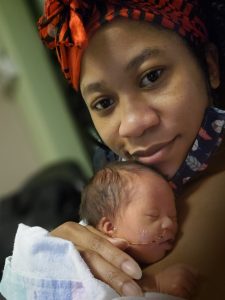
After several emergency office visits and a two-month long hospital stay, Marley Rae Flippen was born at 34 weeks on January 11, 2021, at 4:37 pm. She weighed 4 pounds, 3 ounces and was 17 inches long. “We were terrified because we had had so many complications and she was born so early,” said Gilbert. “But she was finally here, and we were excited!”
Their brief celebration was interrupted by an emergency surgery on her intestinal system. Although difficult and scary for her parents, the surgery was successful, and allowed Marley to surpass all expectations as she began to thrive.
Gilbert stated that her heart was filled with love for her baby and those emotions made all the struggles to bring her into the world seem miniscule in comparison. “She was perfect,” said Gilbert.
After an additional six weeks in the hospital, Marley was sent home to start her new life with her parents. “We were so glad that she made it safely and was thriving,” said Flippen. “We had heard so many negative tales from other people, but she’s quite the little fighter.” Before sending her home, Marley’s care team provided her parents several disability-related resources that included TN Early Intervention System, the Vanderbilt Children’s Down Syndrome Clinic, dietitians, specialized therapists and a pediatrician, all of which they felt appreciative for receiving.
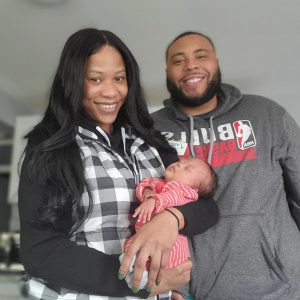
Both parents gleaming with pride stated that they were ecstatic to have Marley home and that she is surpassing every milestone that was expected. Flippen further explained that people seem to equate their baby’s diagnosis with negativity by emphasizing what she wouldn’t do. “There’s nothing negative, we love everything about her,” said Flippen.
“She’s quite aware of her surroundings and her expressions are most rewarding,” Gilbert said. Both parents laugh as Marley, as if on cue, makes a slight sound with a small smirk on her face. “She’s doing well,” said Gilbert.
When asked if there is one thing, she hopes other parents can take away from her story, Gilbert offers advice to prospective parents who may go through similar situations. “Enjoy your pregnancy no matter the diagnosis or the concern. I know that sounds crazy, but we got so wrapped up in the diagnosis and the negatives, that I forgot to just enjoy being pregnant and relish in the fact I was about to become a mother for the first time,” said Gilbert. “No matter what, we love Marley.”
Gilbert explained that it was her faith, her husband, her mother and her family that helped them through what “some may see as a trial, but Miss Marley is a marvelous blessing.”