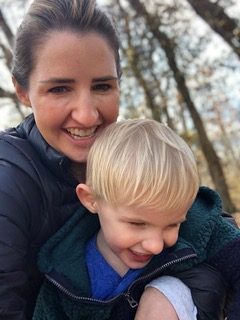
Stacy and Nathaniel’s Story
Nathaniel is a joyful, independent, fun-loving four-and-a-half-year-old boy despite having gone through more medical treatments than most of us will experience in a lifetime. He is also legally blind. He has some light perception in one eye and the bone marrow transplant that saved his life also spared his hearing from the loss that would have occurred. His diagnosis was Malignant Infantile Osteopetrosis.
Experiencing a bone marrow transplant in infancy not only halts a child’s physical development, but Nathaniel’s cognitive/social/emotional development was at a standstill as he fought for his life. A bone marrow transplant is a very drawn-out procedure that doesn’t end after a long hospital stay. Nathaniel spent sixty days between the Vanderbilt Children’s Hematology/Oncology unit and PICU and was discharged to a home environment that resembled a bubble. With no functioning immune system post-transplant, Nathaniel at eight months old could not touch grass or dirt, could not eat most fruits and vegetables, and could have only limited contact with family and his two older siblings. He was weak from months in a hospital bed and still could not sit independently or support weight on his arms or legs. As he reached his medical milestones, we still had mountains to climb to catch up developmentally – and I had never known a person who was blind at any point in my life!
What I learned firsthand in raising Nathaniel’s two older siblings seemed to no longer apply when raising a child with a visual impairment. I had never truly appreciated the importance of vision in early childhood development before having a son with blindness. What motivated my sighted children to crawl did not motivate Nathaniel. And what my sighted children absorbed like sponges from simply watching their environment was not readily available to my visually impaired child. Navigating a completely new world of child development was difficult enough on its own, but on top of that I was not operating at 100%. I was still accepting a life very different than what I expected while ensuring that Nathaniel was medically sound. Nathaniel was not at 100% either as he had become very tactically defensive and had gross and fine motor milestones to meet in order to adequately learn through his other senses. To say it was complicated would be a gross understatement.
I needed a place to turn and that place simply didn’t exist. I needed a specialist to support me during Nathaniel’s early development, not unlike the medical team that guided us through a difficult journey. I needed perspective on where Nathaniel was developmentally, where I could expect him to go, and how to get there. I needed support services that were informed by specialists with knowledge in the unique developmental needs of infants and toddlers with blindness and visual impairments.
The hard truth about Nathaniel’s medical diagnosis is that he was progressively worsening during his first months of life and I didn’t even know. I literally held my son as his bone marrow failed and he went blind, and I was none-the-wiser. An experience like that never leaves you. I vowed that never again would I be in a position to look back and say, “what if.” I couldn’t change the past, but I could decide not to repeat it. Nathaniel still had a period of critical development ahead of him and I was determined to make the most of it – and I’m proud to say I did and continue to do so today.
Other families with young children with blindness and visual impairment may not have the same drive or the same resources. You may never hear their story. But their children are no less deserving of the absolute BEST start. And regardless, it shouldn’t fall on families in fragile situations to find resources.
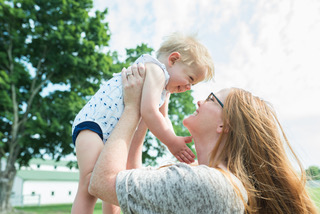
Alison and Finn’s Story
Finn is a sweet, happy, musical and sensitive little three-year-old boy. He was born full-term with no signs of anything wrong during the entire pregnancy. His entry into the world was not without drama as the umbilical cord was twice wrapped around his neck and he was whisked away immediately to the NICU to get him to start breathing. However, his stay in the NICU was short- lived and my fears evaporated when he was brought back to me, placed on my chest and I was assured all was fine. As we awaited our discharge paperwork in the hospital, two days later, the on-call pediatrician examined Finn one last time and noticed some bleeding and other irregularities behind his eyes. We were ordered to stay another night but still assured that there was no major cause for concern. My gut was telling me that there was more to it, but I chalked my fears up to irrational new mom worry. Unfortunately, I soon learned that my gut was right as we were only allowed to leave the hospital with our own assurance to the medical team that we would show up the next morning for an appointment with a pediatric ophthalmologist downtown.
I took my three-day-old baby to that appointment and watched as his eyes were pried open with long metal tools and listened as he screamed. I was three days into being a mother and already felt like I was failing at protecting my son. A string of appointments like this one in the first two weeks of his life that included blood draws, MRIs and other probing tests eventually led us to a retinal surgeon who told us the words we feared most: “Your son is completely blind.”
We proceeded with two surgeries under anesthesia when Finn was just two and four months old desperately trying to bring about any vision we could, but those surgeries failed and in hindsight we regret the unwavering decision to go through with them. We now feel that we made the decision to have our newborn operated on as fearful, sighted individuals trying to make our blind son fit into a sighted world instead of accepting and embracing who he is and was meant to be.
When I first heard the word blind, I immediately thought that my son’s future would be bleak. This was not helped by well-meaning comments or questions from friends, family or strangers. I viewed Finn’s blindness as a loss, not only for me, but for him. I grieved for the life I thought he would have and for the life I thought I was going to have in my new role as a mother. I had never known anyone with a visual impairment or blindness and there was no one offering me insight into what the future might hold so I let the negative assumptions run wild. I’d never felt more alone or more ill-prepared in my life. I have since realized that my son has not lost anything — he never knew a life with vision and thus, never had to grieve or even adapt his way of living in a sighted world. That’s just who he is and what he does. I was the one who had to let go of my fears, preconceptions and misperceptions. I was the one who needed vision, not him.
I searched for services to support Finn, but what I really needed were services to support me. My husband and I needed the tools and knowledge to successfully raise a child who was blind. I’d read all the parenting books out there during my pregnancy, but nothing prepared me for this, and the bulk of my readings no longer applied. Sadly, support services and resources were either not available or had to be piecemealed together from sources both near and far. I was struggling in every way and working hard to advocate for and support both my son and our family only added to the struggle and stress. What I needed most at that time was one place to turn that could have given me answers, support, direction and hope. Sadly, it just did not exist.
The BEST Story
When our boys were born with blindness one year apart in Nashville, TN, we immediately sought out services to help support our sons in their early development. Yet at every place we turned or were referred we were told either that they didn’t serve children birth-to-three or they didn’t have providers specialized in supporting young children with vision-impairment.
After months of advocacy, draining time and energy we simply didn’t have to spare, we were both separately successful in securing a Teacher of the Visually Impaired (TVI) through a temporary agreement between TEIS and TSB. But this was not a lasting solution for families in Tennessee.
When we eventually connected through our shared TVI, we became united in the mission to advocate for and support other families like ours in our home state. Through our new nonprofit organization, Blind Early Services TN (BEST), we are committed to making high-quality, individualized, ongoing and comprehensive services readily available for families like ours and those who follow in our footsteps.
We founded BEST with one goal in mind — to ensure that all families in Tennessee with young children with blindness or visual impairment are empowered and equipped through specialized programs of support to provide their child the absolute BEST start. We have modeled our program after successful agencies and organizations in other states.
We want to become a model for serving children with disabilities, even if that disability is considered to be low incidence as is often said of blindness. No family should feel that their child is at risk of global developmental delays simply because their disability is rare. No family should feel that their child is missing out on services equal to that of their peers simply because of how they were born. And no family should have to fight or stretch themselves mentally, physically or financially, at a time when they are already stretched emotionally.
BEST currently offers three programs of support at no charge to our families:
- Our BEST Together program provides parent-to-parent support and connections, at-home resources, monthly webinars featuring professionals in the fields of early intervention and visual impairment as well as those with lived experience, and a monthly newsletter.
- Our BEST Start program provides in-home, direct early intervention services by providers specifically trained in both early intervention and visual impairment as well as telehealth virtual visits.
- Our BEST Transitions program provides advocacy training and support for families going through the IFSP or IEP process or transitioning from early intervention into the school system.
Please visit our website, social media pages, or sign up for our newsletter to learn more or to stay up to date on all things BEST!
- www.blindearlyservices.org
- www.instagram.com/blindearlyservices/
- www.facebook.com/blindearlyservices